

Imagine a wheel spinning smoothly. Its center is the hub, and from it, strong spokes extend outward. Now, think of the global shipping network as that wheel. Ships are the motion, ports are the spokes, and the hub port is the center that keeps everything connected.
This is a simple but powerful idea of modern maritime logistics. It’s like a spider’s web that connects the world’s ports.
In this article, let’s break down what the hub and spoke model is, how it differs from transshipment, why it’s used in shipping, and what advantages it brings.
What Is the Hub and Spoke Model?

The hub and spoke model is a method used in shipping to organize how cargo moves between ports. Imagine a wheel. The center of the wheel is the hub, and the spokes are the routes that connect it to smaller points. In shipping, the hub is a large, central port that handles the majority of cargo. Smaller spoke ports send and receive goods through this hub instead of dealing directly with every other port.
This idea originally came from the aviation industry. Airlines use major airports as hubs and smaller airports as spokes. Over time, the same concept proved effective in maritime logistics.

(Please note: Port locations and routes are illustrative and may not represent their exact geographical positions.)
For example, the port of Colombo is the hub port in South Asia. Cargo from regional ports like Chennai, Kochi, Tuticorin, Mumbai, Karachi, Chittagong, and Male first comes to the port of Colombo. From Colombo, they are loaded onto a larger mainline vessel to reach the final destination.
In simple terms, the hub and spoke model makes global shipping faster, cheaper, and more organized by using a few powerful hub ports to connect the entire world.
Transshipment vs. Hub and Spoke
Many people confuse transshipment with the hub and spoke model. At first glance, transshipment and the hub and spoke model might sound similar. Both are involved in the transferring of cargo. But there is a difference.

Transshipment
Transshipment simply means transferring cargo from one vessel to another at an intermediate port before it reaches its final destination. This is a one-time transfer and often used when a direct route is not available.
For example, a container from Bangladesh to Brazil might not have a direct service. So, it travels from Chittagong Port to Singapore Port, where it’s loaded onto another ship to travel to Brazil. In this case, Singapore acts as a transshipment port. It is a temporary stop where cargo changes ships.
So, transshipment is a process of moving cargo between ships to reach the destination efficiently.
Hub and Spoke
The hub and spoke model takes the concept of transshipment and builds an entire network around it. This is a strategic network design in shipping. In a hub-and-spoke model system, cargo constantly moves between hub ports and feeder ports.
A transshipment port can be part of a hub and spoke model. But not every transshipment port functions as a full-fledged hub. For example, Singapore, Dubai (Jebel Ali), and Colombo are key hub ports, whereas smaller ports like Male or Tuticorin are spokes in their network.
Both concepts are important functions in global shipping. But the hub-and-spoke system provides greater efficiency and better global connectivity.
Why the Hub and Spoke Model Is Used
The global shipping industry moves over 80% of world trade, connecting with thousands of ports worldwide. Because of that, the hub and spoke model has become more popular in shipping.
Cost Efficiency
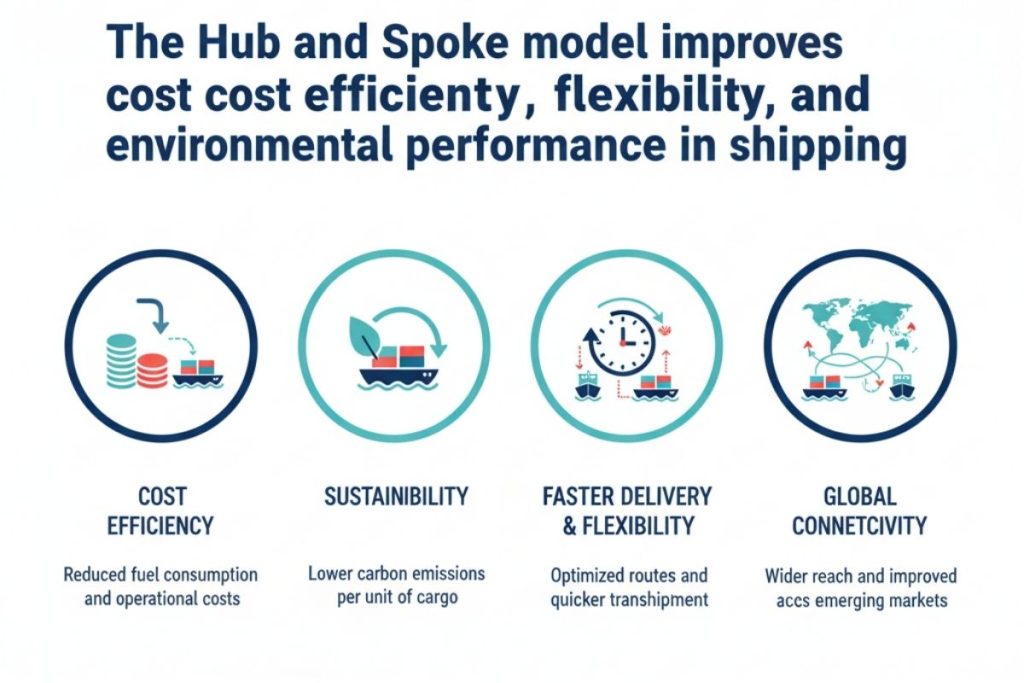
One of the biggest advantages is the reduction in operating costs. Running direct routes between each and every port is expensive. Instead, large ships carry cargo between major hub ports, and smaller feeder vessels connect regional ports. This helps reduce fuel costs, labor expenses, and operational waste.
Global Connectivity
Not every port has the infrastructure or deep water to handle large container ships. The hub and spoke system allows smaller ports to stay connected to international trade routes through feeder services. For example, ports in small island nations like the Maldives or Mauritius can trade globally by linking with hub ports like Colombo, Singapore, or Dubai.
Efficient Cargo Management
Hub ports are equipped with modern technology and specialized terminals for container handling, storage, and customs processing. By concentrating these services in a few locations, shipping lines can streamline their operations and reduce port congestion.
Environmental Benefits
Fewer large vessels mean fewer emissions per container transported. Since the model allows for optimized routes and efficient use of capacity, it supports greener logistics and helps reduce the industry’s carbon footprint.
Increased Frequency of Service
With a hub and spoke structure, feeder vessels operate regularly between regional ports and hub ports. This leads to more frequent shipping schedules and reliable service. Even for smaller destinations that would otherwise have limited shipping connections.
In short, the hub and spoke model is used because it saves money, increases connectivity, and improves the reliability and sustainability of shipping operations.
Challenges of the Hub and Spoke Model
While this model has advantages and usages, it is not without challenges.
Dependence on the Hub: If the hub faces congestion, strikes, or weather delays, the entire network can slow down. For example, when Singapore Port gets congested, regional shipments from Asia can face major schedule disruptions.
Longer Transit Times: As cargo might stop at a hub before reaching the final destination, transit times can increase slightly compared to direct services.
Risk of Bottlenecks: If too many ships arrive at once or customs clearance is delayed, hub ports can face container pileups, affecting the whole network.
Infrastructure Costs: Developing hub ports requires huge investments in cranes, terminals, and technology. Smaller countries may find it difficult to maintain large hub facilities without strong government or private sector support.
Even with challenges, the hub and spoke model will continue in shipping, connecting countries, people, and economies.
Final Thought
The hub and spoke model is not just a logistics system. It is a strategic network in the shipping. This method connects the smallest regional ports to the largest trade centers across the world. From Singapore to Rotterdam and Colombo to Dubai, hub ports manage millions of containers, link countless destinations, and make global commerce possible every day. By linking small ports with large hubs, it allows cargo to move efficiently, sustainably, and affordably.
Read