
Every day, hundreds of ships pass through the Suez Canal. It is one of the most important shipping routes in the world. But, in March 2021, the world had to face an unexpected incident. The Ever Given (IMO 9811000), a massive container ship operated by Evergreen Marine Corporation, got stuck across the Suez Canal. World trade was halted for nearly a week.
This case study explores what happened, why it happened, and what lessons the maritime industry learned from it.
Background: The Suez Canal and the Ever Given
The Suez Canal is a 193-kilometer artificial waterway in Egypt. It opened to shipping in 1869 to connect the Mediterranean Sea to the Red Sea. After the building of the canal, it allows ships to avoid sailing around the Cape of Good Hope in Africa. Nearly 12% of the world’s trade passes through the Suez Canal.
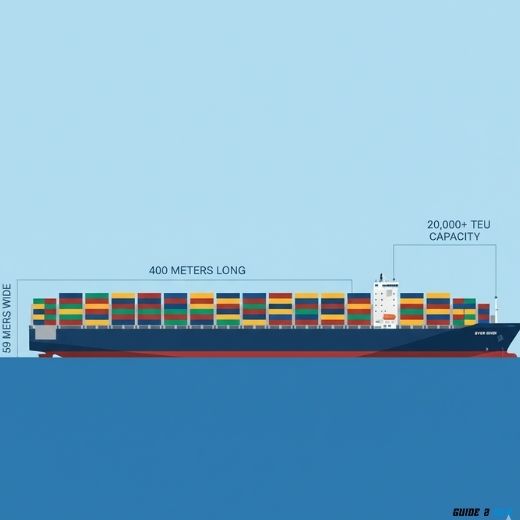
The Ever Given (IMO 9811000) is one of the world’s largest container ships, operated by Evergreen Marine Corporation. It is a Japanese-owned, Panama-flagged container vessel. The vessel is about 400 meters long and 59 meters wide. She can carry over 20,000 TEUs.
The Incident: How the Vessel Got Stuck

On March 23, 2021, the ship was sailing north through the Suez Canal. The weather condition on the southern section of the canal was a challenge to the voyage. Strong winds (up to 40 knots) and a sandstorm had reduced visibility.
This caused the vessel’s bow to strike the eastern bank, and the stern swung across to the western bank. It completely blocked the canal.
Although wind was a factor, investigations later suggested that human error, excessive speed, and limited maneuvering space also contributed to the grounding.
As a result, a single ship brought global maritime traffic to a halt. More than 350 vessels carrying oil, coal, grains, and consumer goods had to wait on both sides of the canal.
Global Consequences of the Blockage
This blockage had a massive impact on the economy. The Suez Canal handles an estimated $9.6 billion worth of goods per day. When the ship was stuck, the entire world felt the impact.
Because of this incident, the world lost around $400 million per hour, and oil prices surged by 2%. Major ports in Europe and Asia had to experience heavy backlogs. Over 400 ships delayed. They had to take the longer Cape of Good Hope route. It added more than 10 days to their voyage.
This single incident revealed how fragile and interconnected global logistics systems are.
Response and Recovery Operations
The Suez Canal Authority immediately began efforts to refloat the vessel. Tugboats and dredgers worked day and night to remove sand and mud from around the bow. Specialized dredgers removed over 30,000 cubic meters of sand from around the ship’s bow. Around 14 tugboats worked to free the vessel.
Finally, on March 29, 2021, the vessel was successfully refloated and the canal reopened.
Legal and Financial Implications
After the incident the vessel moved to the Great Bitter Lake for inspection. The Suez Canal Authority demanded compensation for the losses and rescue efforts. Initially demanded $916 million in compensation for lost revenue, damage to the canal, and salvage costs.
After long discussions, the ship’s owners (Shoei Kisen Kaisha Ltd.) and the insurers (UK P&I Club) agreed to pay an undisclosed settlement estimated at around $550 million.
Egypt detained the vessel for over three months and released it in July 2021. This situation underlined the importance of maritime insurance, liability clarity, and transparent communication during emergencies.
Final Thought
The Ever Given blockage in the Suez Canal was more than a maritime accident. It remains one of the most memorable maritime incidents of the 21st century. This real-life event showed the importance of safety, planning, and teamwork in maritime operations.
References