
The global shipping industry is one of the most leading, competitive, and complex markets in the world. Thousands of ships transport various goods across the world every day. With this, shipping companies face lots of challenges to reduce cost, improve efficiency, and expand their service networks.
To overcome these challenges, many major carriers of the shipping industry have launched alliances to share strategic partnerships with vessels, shipping routes, and port facilities of the world. By working together, shipping alliances have come to agreements to offer flexible sailing, cover more ports, and operate more efficiently.
These shipping alliances have reshaped the efficiency and the operation of the ships. They have created both opportunities and challenges in the industry. Understanding how alliances work in the industry will help to get a clear and vivid idea of how certain careers dominate the shipping industry.
What are the shipping alliances?
Simply, shipping alliances are the cooperative groups or agreements between major shipping companies of the world to share vessels, routes, and port facilities. The carriers in these cooperative agreements coordinate their services to operate more efficiently by reducing cost and covering a wide aspect of shipping and logistics.
When the major carriers of the shipping industry own their own brand and independent businesses, they are still partners to provide services more efficiently. Partners of shipping alliances have agreements on vessel sharing arrangements (VSA) that allow them to place their containers on each other’s vessels. This strategy allows them to provide their services to more locations, increase frequency, and make better use of their vessels without adding extra ships.
There are three major shipping alliances that dominate this industry.
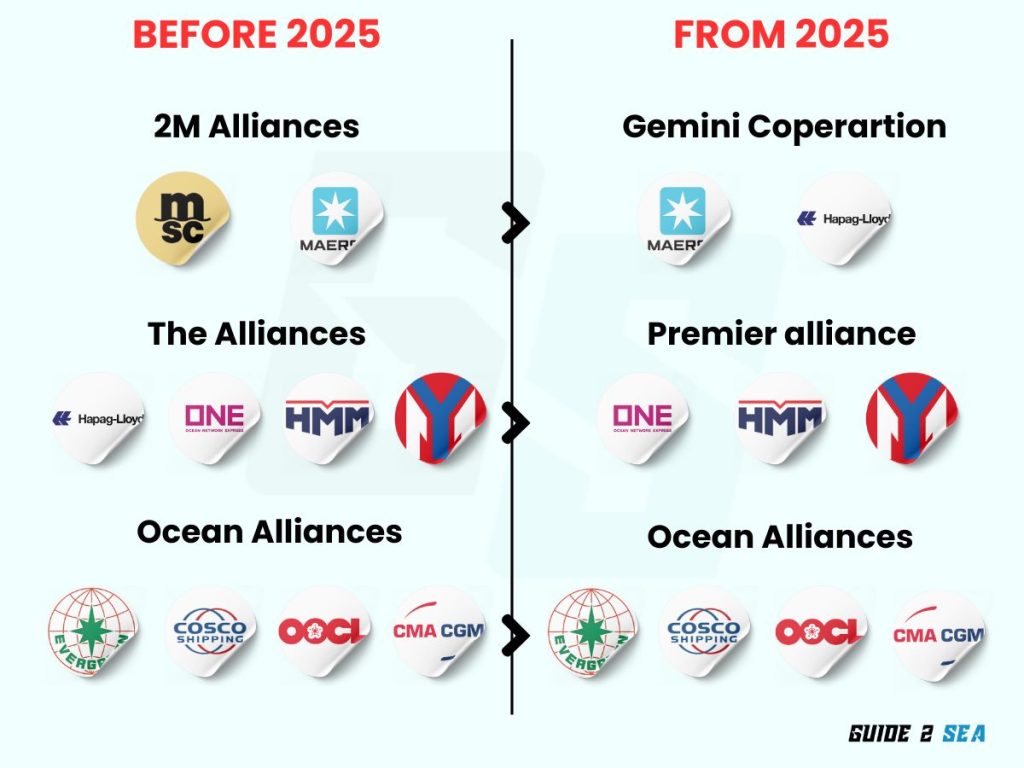
1. The Gemini Corporation
The Gemini Cooperation is the newly launched shipping alliance, which was previously known as the 2M. The 2M was a cooperative agreement between MSC (Mediterranean Shipping Cooperation) and the Maersk shipping line. As the 2M alliance was discontinued in January 2025, the new alliance Gemini Cooperation was launched in February 2025 with the collaboration of Maersk Shipping and Hapag-Lloyd Shipping.
With this partnership, the fleet may expand to about 340 vessels with the expectation of handling around 3.4 million TEUs and cover the main shipping routes, including Asia, Europe, the US, the Middle East, Africa, etc. This allows quick connections from major hub ports to feeder services, improving efficiency and transit time.
2. The Premier Alliance
The formation of Premier Alliance is a partnership among Ocean Network Express (ONE), HMM (Hyundai Merchant Marine), and Yang Ming Marine Transportation that was officially launched in February 2025.
Before 2025, The Premier Alliance was known as “The Alliance.” It started in 2017 with the collaboration of Hapag-Lloyd, HMM, Ocean Network Express (ONE), and Yang Ming. As The Alliance was left off, The Premier Alliance was officially launched in February 2025.
Together they are expected to cover major shipping routes linking Asia with North America, Europe, the Mediterranean, and the Middle East.
3. The Ocean Alliance
The Ocean Alliance, which was formed in 2017, is a collaboration of larger shipping companies: Evergreen, CMA CGM, COSCO Shipping, and OOCL. As announced, the Ocean Alliance has extended their agreement for another 5 years, which starts from 2027. Until today, the Ocean Alliance covers major East-West shipping routes, including Asia-Europe, Trans-Pacific, and Trans-Atlantic.
This Vessel Sharing Agreement (VSA) allows carriers to share vessels and shipping routes with the expectation of providing frequent and flexible sailing access to more destinations.
Benefits of Shipping Alliances
Shipping alliances are strategic partnerships between major carriers of the shipping and logistics industry that offer benefits and reshape global trade by working together.
One of the key benefits of the shipping alliances is “cost efficiency.” The concept of shared vessels, routes, and port calls helps to reduce operational costs. Instead of deploying extra vessels to the route, shipping alliances focus on distributing goods to more destinations within a single voyage, which helps to reduce labor, fuel, maintenance, and operational expenses.
Another important benefit is “expanding of network and coverage.” Through the shipping alliances, they are covering wide aspects of global shipping by providing services to both hub ports and feeder ports. Through this, ships get access to more ports and smoother connections between countries.
By optimizing the use of vessels and reducing unnecessary port calls, it helps to lower fuel consumption and emissions, supporting sustainable shipping practices. Shipping alliances also provide a flexible trade in response to the fluctuation and deflation of the economy.
Final Thought
Shipping alliances have become significant players in the maritime industry. By working together they have come to the agreement to offer a wide service network, reduce operational cost, improve reliability, and promote sustainable shipping practices. Understanding how these alliances work helps to get a vivid idea about how they contribute to the maritime and logistics industry.