
You have probably seen vehicles carrying one or two metal boxes on the road. These boxes are in different colors. Those boxes are called shipping containers. They may look simple. But they are more important than they appear. These containers are the pillar of international shipping and logistics. From clothes, electronics to foods and machinery, most of the products we consume are transported inside these boxes. Every day, they move tons of goods across the seas and countries.
Let’s take a closer look at shipping containers and how they matter to global trade.
What is a shipping container?
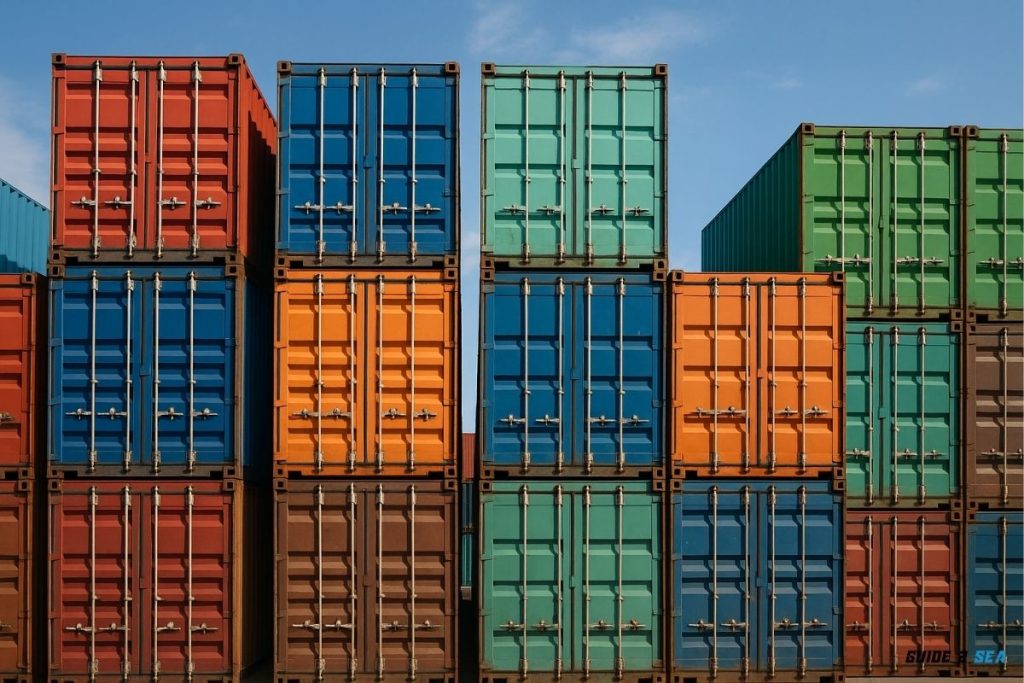
As mentioned, a shipping container is a large, durable, and standardized metal box, usually built with strong steel. They are designed to move goods safely over long distances. The special thing is that the same container can be used on different modes of transport: ships, trucks, and trains. This system is known as ‘intermodal transport.’ It reduces time, costs, and the risk of damage or theft during transportation.
Shipping containers are designed to withstand rough weather, rough seas, and heavy loads to ensure that cargo reaches the destination without any damage. They were also made easy to stack, load, and unload with cranes and other equipment because of the standardization. By today, there are different types of containers with different dimensions. Without them, global shipping trade would not be efficient or effective.
History of Shipping Container
Before introducing containers to the world, there wasn’t a proper way to handle goods. Until the 20th century, goods were handled manually and in bulk format. Break-bulk shipping was one of the common ways of moving goods through the shipping routes. This method required more labor and took more days or weeks in ports and often led to damage or theft of goods. It made cargo handling one of the biggest challenges in the trade.
In 1956, an American entrepreneur, Malcom McLean, marked a significant turning point in shipping and logistics by introducing the container to the world. This invention made a remarkable change in global trade by using large and standardized containers to carry goods. This simple innovation transformed the whole shipping industry into a new era. This concept is called “containerization.”
During the period of 1960 to 1970, containerization spread all around the world. Everything related to shipping—ships, equipment, cranes, vehicles, roads, and yards—was completely redesigned according to the size of the containers. In 1968, the ISO (International Standard Organization) standardized the size of containers. Today, over 85% of world trade moves in containers with much efficiency.
Container Sizes and Standards
Containers may look similar. But all are built under the guidelines of the international standards of ISO. This means whether a container is loaded in Asia or shipped to Europe or transported by rail in North America, the container is designed to fit perfectly with the global transport system. Standardization allows containers to be stacked neatly on ships and in yards and also makes it easy to move them with cranes and transfer them between ships, trucks, and trains. By today, there are different types of containers by different companies.

The most common way of measuring a container is the TEU (Twenty-foot Equivalent Unit) to represent a standard-size container of 20 ft. The other size is FEU (Forty-Foot Equivalent Unit), which represents a 40 ft container. Usually, an FEU is also called a 2TEU in the industry. 20 ft containers and 40 ft containers are the most common types used in shipping and logistics. Some containers are built taller to handle more cargo. They are known as high-cube containers specially used to transport garment products. High cubes differ in height. They are 9.6 ft high. clothing. Except for that, there are also 45 ft, 48 ft, and 53 ft long containers.
| Container Type | Length | Width | Height |
|---|---|---|---|
| 20 ft (TEU) | 20’ | 8’ | 8.6’ |
| 40 ft (FEU) | 40’ | 8’ | 8.6’ |
| 20 ft (HC – High Cube) | 20‘ | 8’ | 9.6’ |
| 40 ft (HC—High Cube) | 40’ | 8’ | 9.6’ |
Importance of Shipping Container
Shipping containers are one of the most important inventions in global trade. They play a vital role in transporting goods from one location to another location. By today over 90% of goods are transported by these containers. Because of that, containers are important in several ways.
1. Speed—Speed is one of the major benefits. Containers can be loaded and unloaded quickly by using cranes and other handling equipment. This reduces the time and boosts the efficiency by allowing ships to move goods within a short time frame.
2. Security—Containers are designed with proper security systems like locking mechanisms and waterproof seals to protect goods from theft, damage, and rough weather conditions during the transit of the goods.
3. Cost effectiveness—use of standard-size containers reduces the labor needed, handling, storage, and transportation costs and helps businesses to save money and increase their profits.
4. Environmental benefits—The use of containers helps to reduce waste and energy consumption by minimizing cargo handling and optimizing transportation routes.
5. Versatility—Shipping containers can be used for different types of goods, from perishables to machinery, and can be used for specific cargo needs, such as refrigeration or oversized items.
6. Global trade facilitation—The invention of containers revolutionized global trade by making it easier to transport goods over long distances. Without containers, modern economy and global trade networks wouldn’t be easy.
Final thought
Shipping containers may look like nothing more than a steel box. But it is the foundation of modern global trade. From the invention of containers in the 20th century to today, they have improved the efficiency and effectiveness of global trade by reducing time, cost, and labor needs.
In short, shipping containers are not just boxes. They are the key players of the global supply chain. With numerous benefits, containers make sure the world stays connected through trade. By providing a standardized, secure, and efficient way to transport goods, containers have transformed shipping into a new era.

